
When I started InfiniteGrammar.de, the key question was not "How do I build a German learning app?"
The real question was narrower:
Where is there a repeated, high-stakes need for much more grammar practice than the market usually provides?
The answer was not "German learners in general."
It was learners preparing for recognised exams such as telc and TestDaF.
That distinction matters.
A large part of this demand is not casual. People need certificates for university admission, professional pathways, visa and residence processes, and sometimes citizenship-related requirements. At that point, B1, B2 and C1 stop being abstract CEFR labels. They become thresholds with consequences.
That changes the product problem completely.
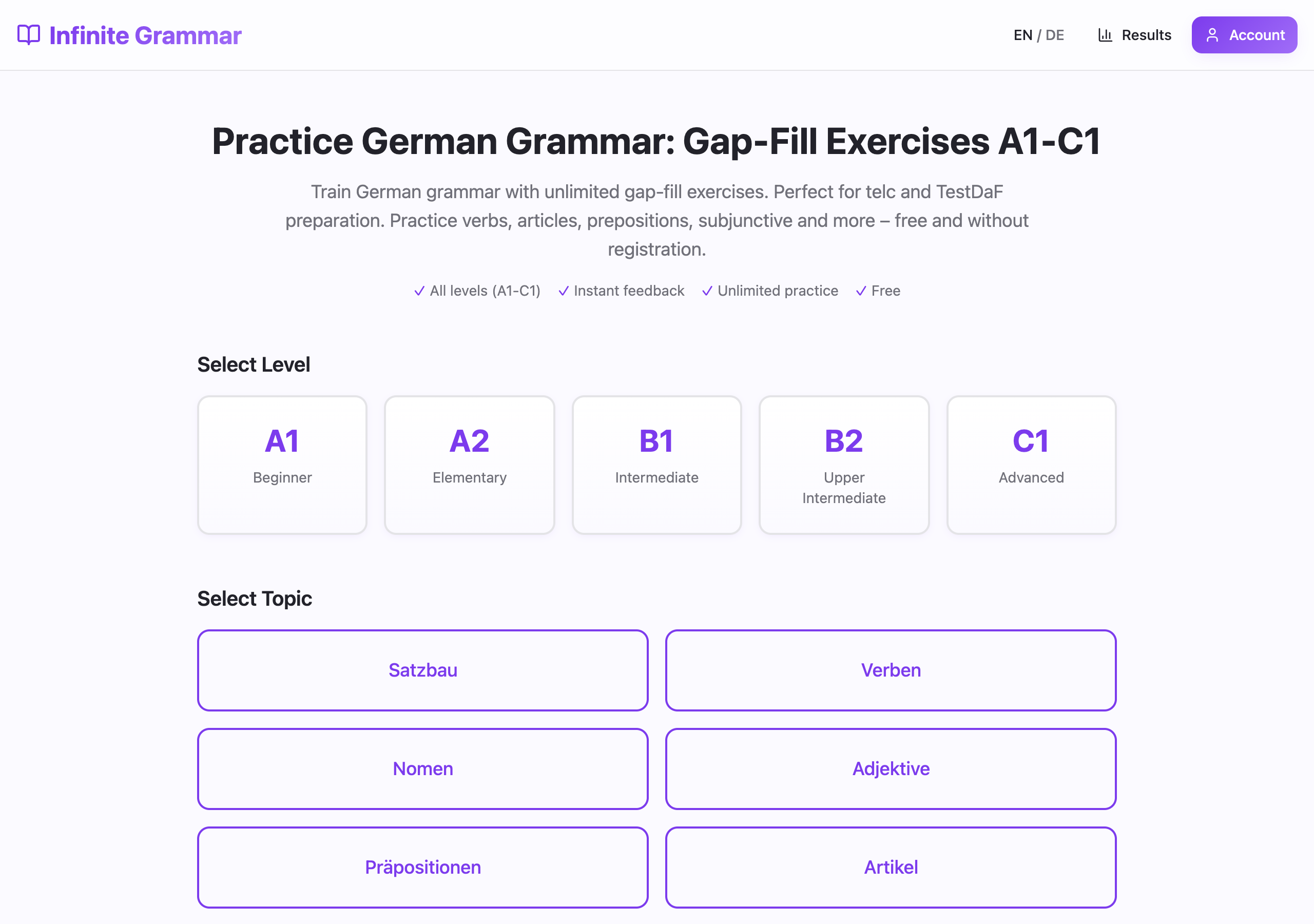
This is no longer open-ended language learning. It is preparation under constraints:
- a CEFR level has to be reached,
- the result is externally evaluated,
- the timeline is usually fixed,
- and weak areas become visible very quickly.
The bottleneck is usually not the rule itself
Exam preparation makes one thing painfully clear.
Many learners already know the rule they are failing to apply.
They have seen adjective endings before. They know that certain verbs require specific prepositions. They understand subordinate clause word order. They have encountered passive forms, nominalisation, or Konjunktiv structures.
But that does not mean they can use them reliably.
Recognition is not the same as performance.
What exam-oriented learners often need is not one more explanation. They need enough repetitions for a grammar pattern to become usable under pressure, in context, across many variations.
That is especially visible at B1, B2 and C1. At those levels grammar stops being mainly about isolated forms and starts becoming about controlled use inside denser sentences, formal registers, and exam-style text tasks.
The market gap is not grammar content in general
If the problem were simply "learners need grammar," the market would already be serving it reasonably well.
There is no shortage of grammar material:
- textbooks explain the rules,
- prep books organise content by exam level,
- apps provide broad progression,
- teachers and blogs cover common pain points.
The scarce resource is something more specific:
Depth of targeted practice for one narrow grammar section.
That means the real product unit is not "German B2." It is something much smaller and much more actionable:
- B2 verbs with fixed prepositions,
- B1 adjective declension in context,
- C1 nominalisation in formal written German,
- B2 connectors inside text-level logic,
- C1 passive constructions in academic or administrative contexts.
This is where the supply side gets thin.
A learner can usually find an explanation. A learner can often find a small worksheet. A learner can sometimes find broad mixed practice. What is much harder to find is hundreds of contextual exercises for one precise grammar area, with enough variation to build fluency rather than recognition.
That is the gap InfiniteGrammar.de explores.
Why gap-fill became the core format
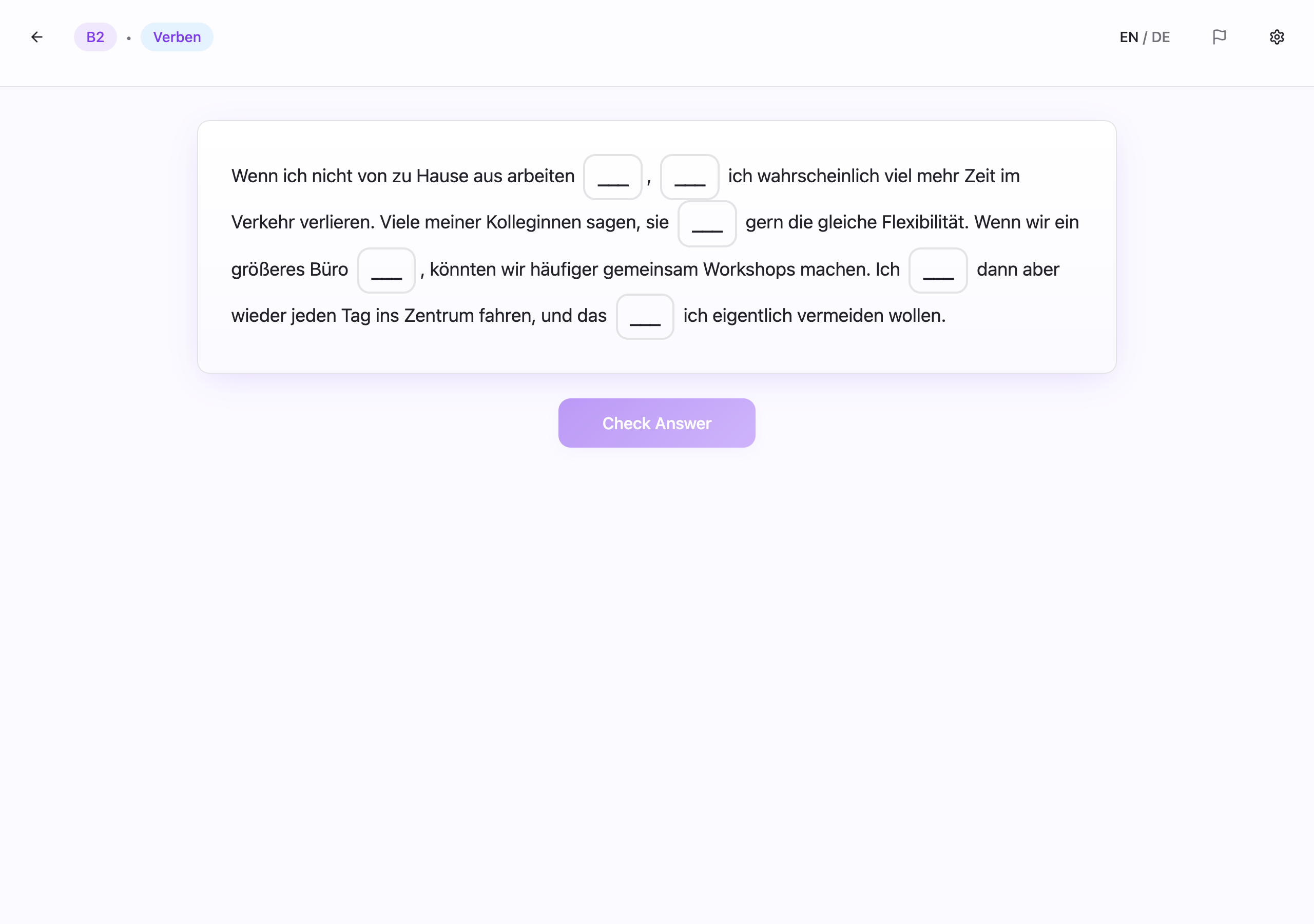
The product is built around gap-fill exercises with several blanks, multiple answer options, and explanations.
Gap-fill sits close to the actual failure mode in exam preparation. The learner is not being asked whether they vaguely know the rule. They are being asked to apply it in context, under constraint, while distinguishing the correct form from nearby alternatives.
That makes the format useful for two reasons.
First, it is close enough to real exam pressure to be relevant. Second, it is structured enough to scale as a content system.
The product is not trying to imitate telc or TestDaF directly. But the task design and the scenario design are clearly shaped by the fact that many learners work toward those kinds of exams.
Why the content model is CEFR x grammar section x scenario
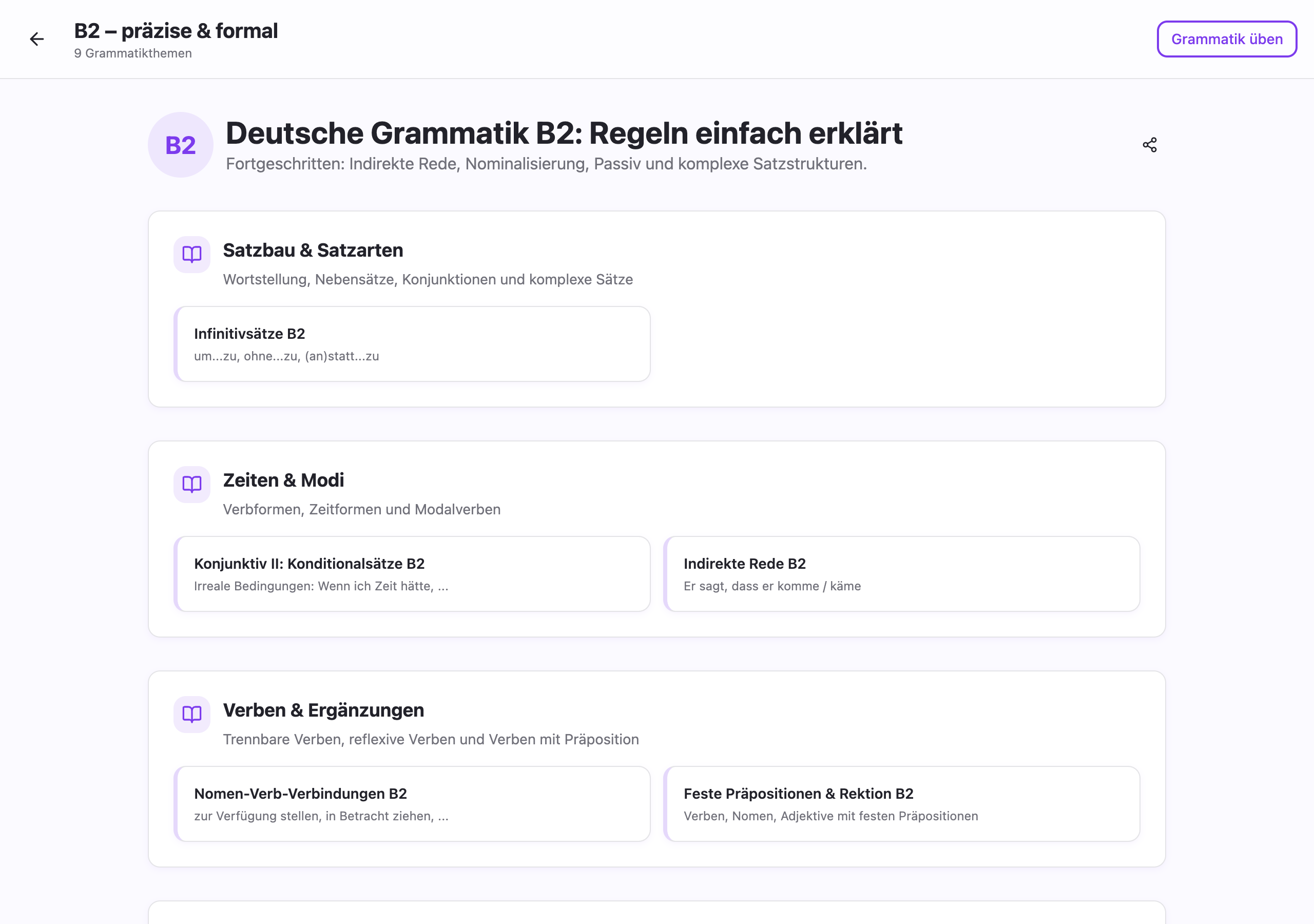
A second early decision was to structure content across three axes at once:
- CEFR level
- Grammar section
- Content topic used in telc and TestDaF exams
The CEFR layer keeps the system legible. The grammar-section layer makes practice precise enough to matter. The scenario layer keeps the exercises from collapsing into abstract drills.
This matters because grammar alone is not the whole learning unit. Vocabulary domain, sentence frame, and communicative situation all change how sticky a grammar pattern becomes.
The topic layer is therefore not decoration. It is part of the transfer logic.
It also supports the exam-oriented use case. Many scenarios sit close to domains that repeatedly matter in preparation and later real life: work, education, housing, bureaucracy, formal communication, applications, and public life.
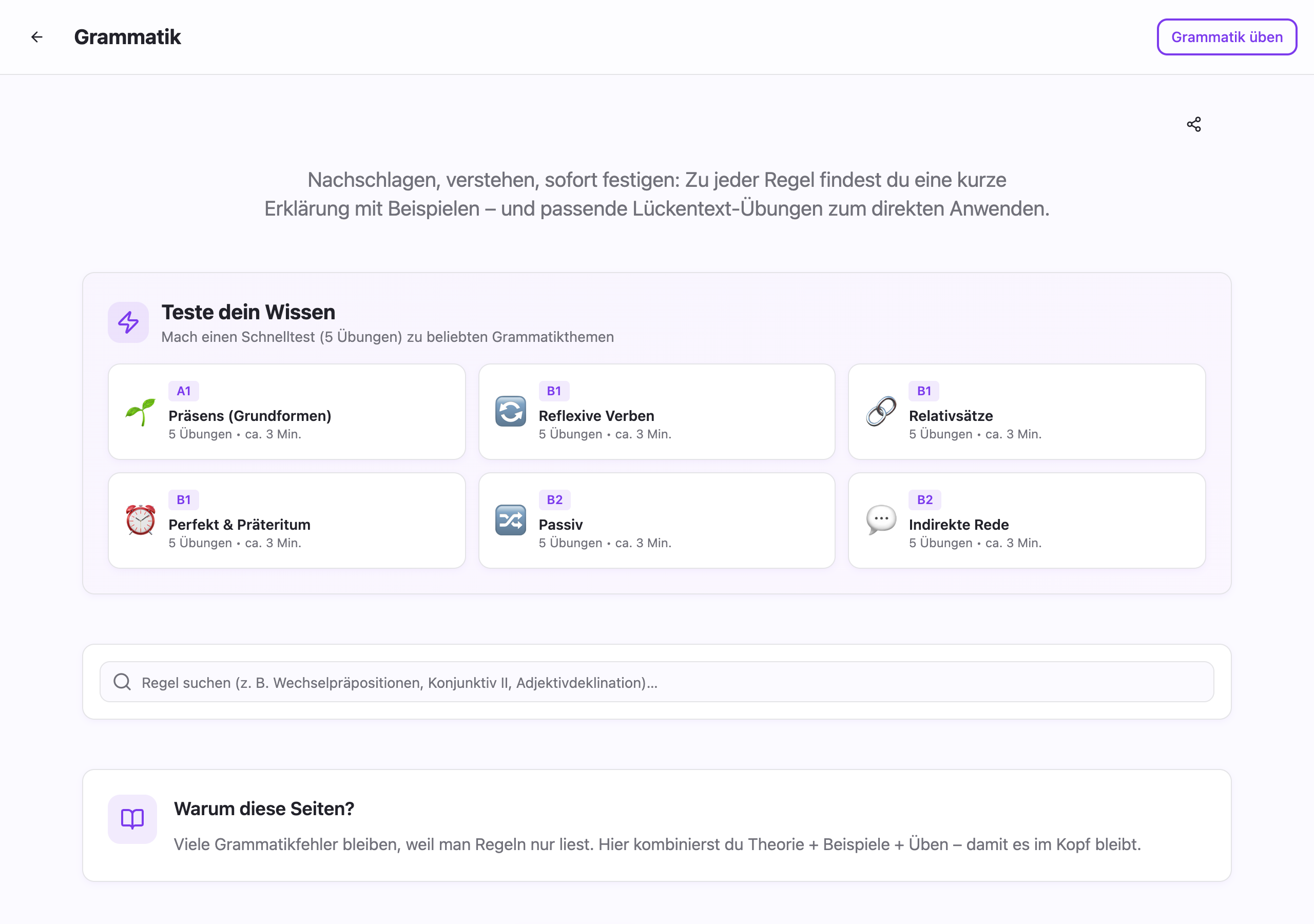
Why the product had to go deeper rather than broader
A lot of language products optimise for breadth. They cover many topics and give a small number of tasks for each.
That is easy to market and weak in use.
The more useful direction here was the opposite: depth.
The product goal became:
Make it possible for a learner to stay inside one grammar area long enough to get meaningful repetition without immediately cycling through the same exercise patterns.
That decision quietly shaped almost everything that came later:
- narrower grammar sections,
- more exercises per section,
- explanations on every gap,
- analytics for coverage,
- similarity analysis to detect redundancy,
- and section-based retention instead of generic reminders.
This is one of those cases where product strategy quietly commits you to infrastructure. Once the promise becomes "targeted depth," you need a way to produce depth, measure depth, and keep depth from degenerating into repetition.
What this means in product terms
The product decision was:
Build a system that can provide high-volume, scenario-grounded, level-specific grammar practice exactly where exam pressure is real and existing materials become shallow.
Once the problem was framed that way, the rest of the system followed naturally:
- LLM generation became worth exploring,
- explanations became mandatory,
- similarity analysis became necessary,
- the admin area needed coverage and demand views,
- and retention needed to be tied to grammar sections rather than generic engagement loops.
InfiniteGrammar.de started from a narrow but persistent gap.
Not lack of German grammar content.
Lack of enough targeted practice for grammar to become usable under pressure.